AI Agents and Agentic AI in 2026: How Autonomous Systems Are Becoming Digital Coworkers
AI Agents and Agentic AI in 2026: How Autonomous Systems Are Becoming Digital Coworkers for the Enterprise
Artificial intelligence is moving beyond simple chatbots and single-task automation. In 2026, the biggest shift in enterprise technology is the rise of AI agents: intelligent software systems that can understand goals, plan actions, use tools, collaborate with other agents, and complete complex workflows with limited human supervision. This evolution is often called agentic AI, and it is quickly becoming one of the most important AI trends shaping the future of business.
Organizations are no longer asking whether AI can generate text, summarize documents, or answer questions. They are now asking whether AI can run business processes, coordinate across departments, make decisions based on real-time data, and act as a reliable digital coworker. This is where autonomous agents and multi-agent systems are transforming enterprise AI.
What Are AI Agents?
AI agents are intelligent software programs designed to perform tasks on behalf of users or organizations. Unlike traditional automation tools that follow fixed rules, AI agents can interpret instructions, reason through problems, interact with software applications, retrieve information, and take action.
A basic automation system might send an email when a form is submitted. An AI agent, however, could read the form, determine the customer’s intent, check CRM history, draft a personalized response, update the customer record, escalate urgent cases, and schedule a follow-up meeting.
This ability to combine reasoning, planning, and action makes AI agents significantly more powerful than earlier generations of AI tools.
What Is Agentic AI?
Agentic AI refers to artificial intelligence systems that can act with a degree of autonomy. Instead of waiting for step-by-step human instructions, agentic AI systems can pursue objectives, break them into smaller tasks, select tools, evaluate outcomes, and adjust their behavior.
For example, if a sales manager asks an AI agent to “prepare a list of high-priority leads for this week,” an agentic AI system may:
- Analyze CRM data
- Review recent customer interactions
- Identify leads with buying intent
- Prioritize accounts based on deal size and urgency
- Draft outreach messages
- Schedule tasks for sales representatives
- Generate a summary report
The key difference is that agentic AI does not simply respond. It acts.
Autonomous Agents: The Next Step in AI Automation
Autonomous agents are AI systems capable of completing tasks with minimal human intervention. They can monitor environments, make decisions, and execute workflows across multiple tools or platforms. In the enterprise, autonomous agents are being used for customer service, cybersecurity, finance operations, human resources, IT support, marketing, procurement, and supply chain management.
Autonomous agents are especially valuable because modern businesses operate across many disconnected systems. Employees often spend hours switching between email, spreadsheets, dashboards, CRMs, ERPs, ticketing systems, and communication tools. AI agents can reduce this manual effort by acting as a layer of intelligence across enterprise software.
For example, an autonomous finance agent could detect unusual invoice patterns, verify vendor details, compare purchase orders, flag potential fraud, and route approvals to the correct department. This saves time while improving accuracy and compliance.
Multi-Agent Systems: When AI Agents Work Together
One of the most exciting developments in enterprise AI is the rise of multi-agent systems. A multi-agent system involves multiple AI agents working together to solve a problem or complete a workflow. Each agent may have a specialized role, such as research, analysis, planning, execution, quality control, or communication.
In a marketing department, a multi-agent system might include:
- A research agent that analyzes market trends
- A content agent that drafts campaign materials
- A design agent that recommends creative concepts
- A data agent that monitors campaign performance
- A compliance agent that checks brand and legal guidelines
- A reporting agent that summarizes results for leadership
Instead of relying on one general-purpose AI model to handle everything, multi-agent systems distribute tasks across specialized agents. This can make workflows more accurate, scalable, and transparent.
In 2026, multi-agent systems are expected to become a major part of enterprise AI because they mirror how human teams work. Different agents can collaborate, review one another’s outputs, and complete complex business processes faster than isolated tools.
Digital Coworkers: AI as Part of the Workforce
The term digital coworkers describes AI agents that function like virtual members of a team. These systems are not replacing every human role, but they are changing how work gets done. Digital coworkers can handle repetitive, data-heavy, and process-driven tasks, allowing human employees to focus on strategy, creativity, relationship building, and decision-making.
A digital coworker may help an HR team screen resumes, schedule interviews, answer employee policy questions, and prepare onboarding documents. In customer support, digital coworkers can resolve common tickets, summarize customer histories, suggest solutions to human agents, and follow up after cases are closed.
The value of digital coworkers comes from their ability to operate continuously, access large volumes of information, and maintain consistent performance. They can work across time zones, support global teams, and reduce operational bottlenecks.
However, successful adoption requires clear governance. Companies must define what digital coworkers can do independently, when they need approval, and how their actions are monitored.
Enterprise AI and the Shift from Tools to Teammates
For years, enterprise AI focused on predictive analytics, robotic process automation, and business intelligence. While these technologies remain important, the future of enterprise AI is more dynamic. Businesses are moving from AI as a tool to AI as a teammate.
This shift changes the role of AI in the organization. Instead of being used only by technical teams or data scientists, AI agents can support employees across every department. Sales teams can use agents to manage pipelines. Legal teams can use agents to review contracts. IT teams can use agents to resolve support tickets. Executives can use agents to monitor business performance and generate strategic insights.
Enterprise AI in 2026 will be defined by integration. AI agents must connect securely with internal systems, understand company-specific processes, follow compliance requirements, and deliver measurable business outcomes.
Key Benefits of AI Agents for Businesses
The growing adoption of AI agents is driven by several business benefits.
1. Increased Productivity
AI agents can automate time-consuming tasks such as data entry, report generation, email drafting, document review, and workflow coordination. This helps employees complete more work in less time.
2. Faster Decision-Making
By analyzing large amounts of data quickly, AI agents can provide recommendations, identify risks, and surface opportunities. Leaders can make more informed decisions without waiting for manual analysis.
3. Lower Operational Costs
Autonomous agents can reduce the cost of repetitive processes by minimizing manual labor, errors, and delays. This is especially useful in finance, customer service, procurement, and IT operations.
4. Improved Customer Experience
AI agents can provide faster responses, personalized communication, and consistent support. When combined with human oversight, they can improve customer satisfaction while reducing support volume.
5. Better Scalability
Digital coworkers can support growing workloads without requiring the same level of hiring or infrastructure expansion. This makes AI agents attractive for fast-growing enterprises.
AI Trends 2026: What to Expect
Several major AI trends in 2026 will shape the development and adoption of agentic AI.
1. AI Agents Will Become More Specialized
Rather than using one general AI assistant for every task, companies will deploy specialized agents for sales, finance, HR, legal, operations, cybersecurity, and customer support. These agents will be trained or configured around specific workflows and business rules.
2. Human-in-the-Loop Will Remain Essential
Even as autonomous agents become more capable, human oversight will remain important. Enterprises will use approval layers, audit trails, and escalation rules to ensure responsible AI usage.
3. Multi-Agent Collaboration Will Expand
Businesses will increasingly adopt multi-agent systems where different agents collaborate across departments. This will enable more advanced automation for complex workflows such as product launches, financial planning, and incident response.
4. AI Governance Will Become a Competitive Advantage
As AI agents take more actions, companies will need strong governance frameworks. Security, privacy, compliance, explainability, and accountability will become central to enterprise AI strategy.
5. Digital Coworkers Will Become Common in Daily Work
By 2026, many employees may interact with digital coworkers as naturally as they use email or messaging apps today. AI agents will join meetings, summarize discussions, update tasks, prepare documents, and coordinate follow-ups.
6. Integration Will Matter More Than Model Performance Alone
The best enterprise AI systems will not only have powerful models. They will also integrate deeply with business applications, databases, communication platforms, and security systems. Practical value will depend on execution, not just intelligence.
Challenges of Agentic AI Adoption
Despite the promise of AI agents, enterprises must address several challenges.
Security Risks
Autonomous agents often need access to sensitive systems and data. Without proper controls, they could expose confidential information or take unauthorized actions.
Accuracy and Reliability
AI agents can make mistakes, especially when dealing with ambiguous instructions or incomplete data. Businesses need validation systems, monitoring, and fallback processes.
Compliance Requirements
Industries such as finance, healthcare, insurance, and legal services must ensure that AI agents comply with regulations. This includes data privacy, recordkeeping, and decision transparency.
Change Management
Employees may be uncertain about working with digital coworkers. Organizations need training, communication, and clear role definitions to build trust and adoption.
Workflow Complexity
Many business processes are not fully documented. Before deploying AI agents, companies may need to map workflows, clean data, and standardize procedures.
How Enterprises Can Prepare for AI Agents
To successfully adopt agentic AI, businesses should start with focused use cases. Instead of trying to automate everything at once, organizations should identify high-value workflows with clear inputs, outputs, and success metrics.
Good starting points include:
- Customer support ticket triage
- Sales lead qualification
- Invoice processing
- Employee onboarding
- IT help desk automation
- Contract review support
- Meeting summaries and action tracking
- Market research and reporting
Enterprises should also establish governance from the beginning. This includes defining permissions, approval requirements, data access rules, performance monitoring, and escalation paths.
The most successful companies will treat AI agents as part of an operating model, not just another software feature.
The Future of Work with AI Agents
The rise of AI agents does not mean humans will disappear from the workplace. Instead, work will become more collaborative between humans and intelligent systems. Employees will spend less time on repetitive tasks and more time directing, reviewing, and improving AI-assisted workflows.
In this new model, human skills such as judgment, creativity, empathy, leadership, and strategic thinking become even more valuable. AI agents can process information and execute tasks, but humans provide purpose, ethics, and business direction.
By 2026, companies that successfully combine human expertise with autonomous agents will gain a major advantage. They will operate faster, serve customers better, reduce costs, and adapt more quickly to market changes.
Conclusion
AI agents, agentic AI, autonomous agents, multi-agent systems, and digital coworkers represent the next major evolution of enterprise AI. These technologies are moving artificial intelligence from passive assistance to active execution. As AI trends in 2026 continue to accelerate, organizations will increasingly rely on intelligent agents to automate workflows, support employees, and improve business performance.
The enterprises that succeed will not be those that simply adopt the latest AI tools. They will be the ones that redesign work around human-AI collaboration, implement strong governance, and deploy AI agents where they create measurable value. In the coming years, digital coworkers will become a normal part of business operations, and agentic AI will play a central role in shaping the future of work.
Sources
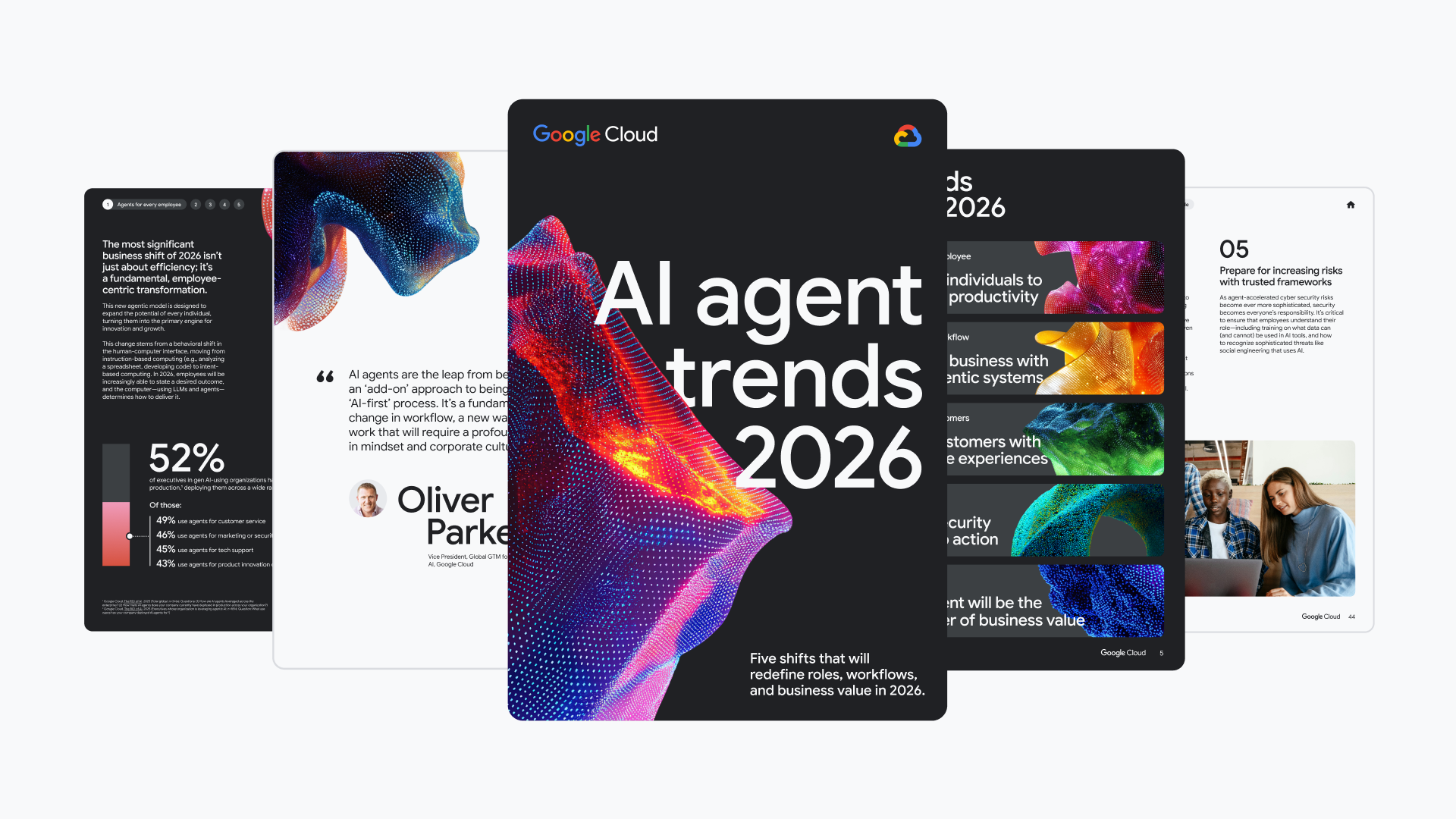
1. Google Cloud - AI Agent Trends 2026
Link - Discover the five trends driving business transformation in 2026 backed by insights from global executives.
2. Forbes - The 8 AI Agent Trends For 2026

Link - Agents represent the next generational leap forward for AI, capable of taking action and working towards long-term goals.
3. MachineLearningMastery - 7 Agentic AI Trends to Watch in 2026
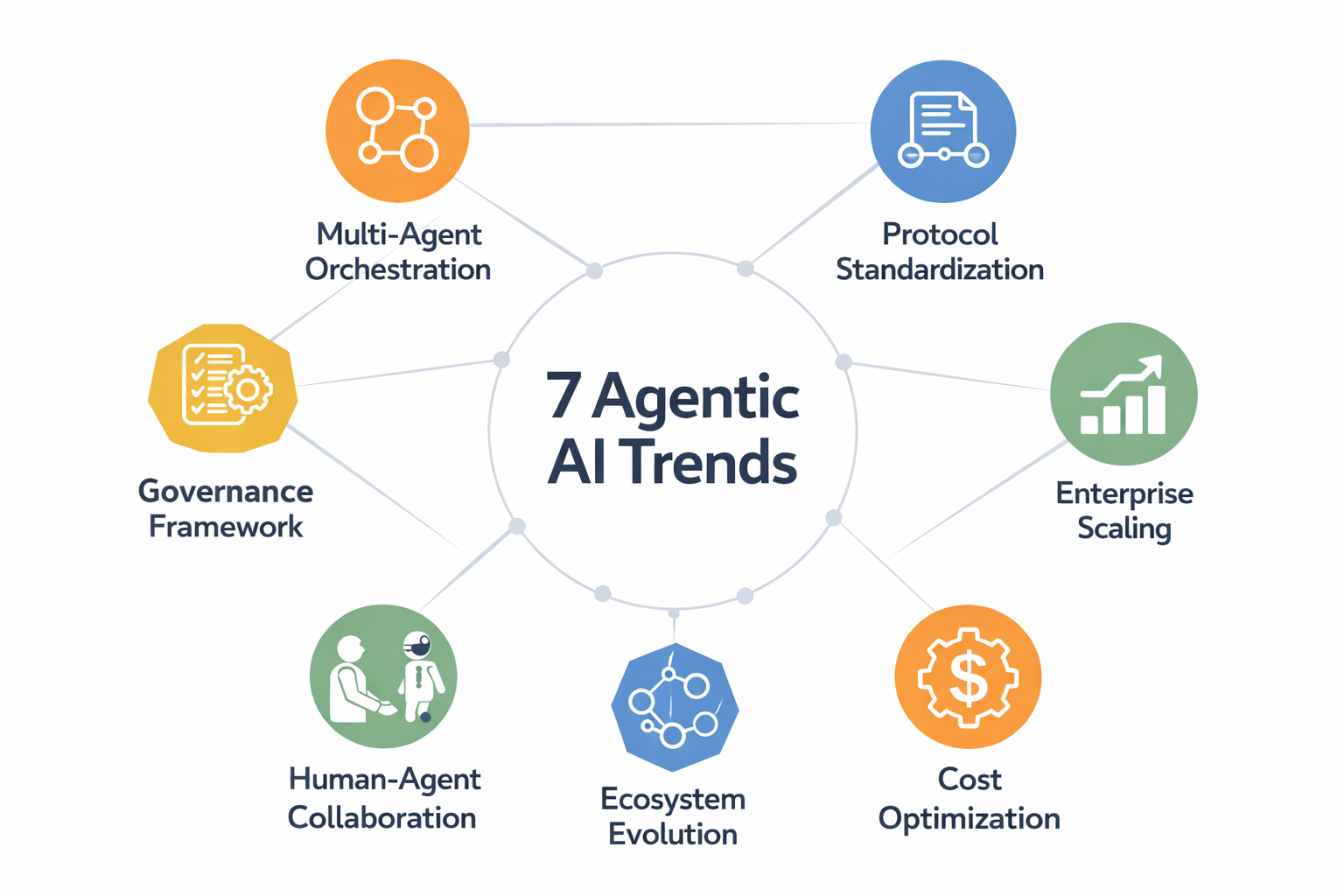
Link - Industry analysts project the market will surge from $7.8 billion today to over $52 billion by 2030.
4. ACTGSYS - Google Predicts 5 Major AI Agent Trends
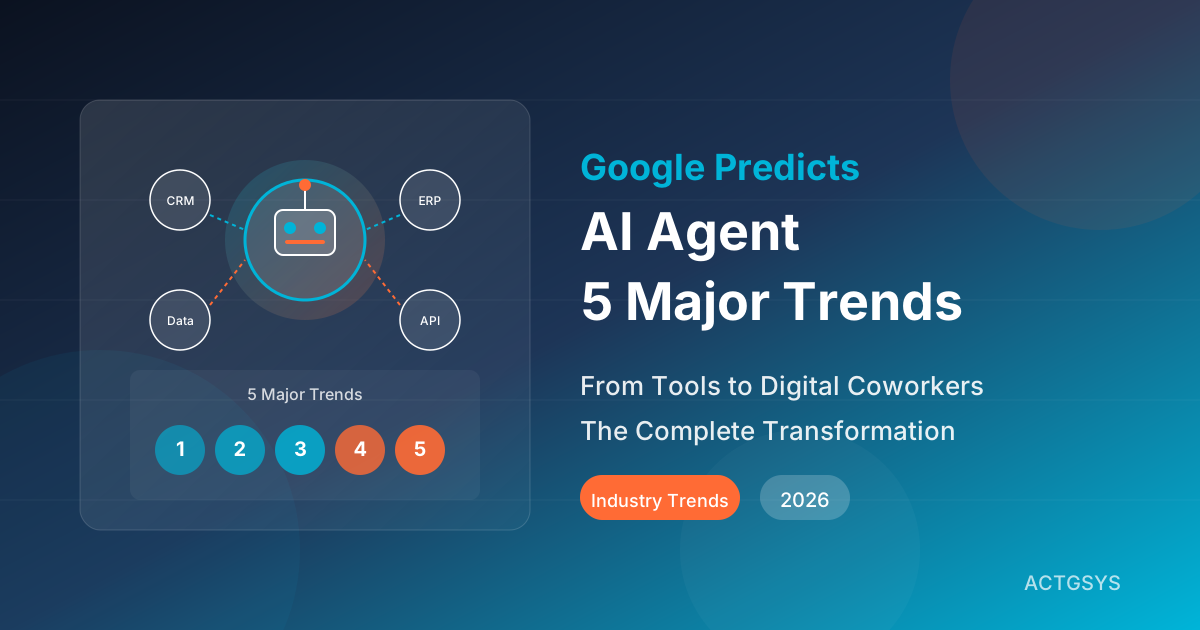
Link - AI Agents are transforming from assistive tools to autonomous digital coworkers.